Turning passive score-checking into meaningful daily insight
Oura delivers powerful biometric insights, now paired with a daily self check that captures how users feel and connects it to their data for clearer interpretation.
Users regularly check their wearable scores, yet the experience lacks a way to track how they feel alongside their data over time, making it difficult to interpret insights and sustain meaningful engagement.
Problem
Solution
A daily self check that captures how users feel before viewing their data, creating a simple way to compare perception with metrics over time and support clearer interpretation and more intentional engagement.
Outcome
100% task completion
38s avg. completion time
Role
UX Designer
Timeline
3 weeks
Key Insights from User Research
Wearable users regularly check their biometric scores, yet the experience is largely passive, limiting how they interpret and connect with their health data over time.
Score-checking drives behavior, not understanding
71% of users check their wearable daily or more, reinforcing a habit built around quick score consumption rather than deeper engagement.
Perception and data frequently feel misaligned
Many users form an expectation before opening the app, but when data doesn’t match how they feel, there is no clear way to capture or understand that gap, reducing trust.
No structured way to track how they feel over time
While biometric data is continuously tracked, subjective experience is not, making it difficult for users to recognize patterns or build meaningful insight.
Translating Insights into Design Direction
Affinity Mapping
I synthesized interview and usability findings into core behavioral themes to identify where the current wearable experience breaks down and where design could create the most impact.
Lack of subjective tracking
Desire for trend-based insights
Routine-based usage
Passive engagement
Perception vs. data misalignment
User Personas
With these themes in place, I defined two core user archetypes that highlighted the same underlying tension in different ways. Alex needed structured reflection to better understand and trust their data. Taylor needed a low-effort interaction that fit naturally into an existing routine.
The solution had to serve both. Lightweight enough to maintain habit, meaningful enough to deepen engagement.
Persona Archetype 1: Alex (Score-Driven Optimizer)
Persona Archetype 2: Taylor (Routine-Based Checker)
Key Flows Mapped
I mapped the existing morning interaction to understand how users engage with their data today and where reflection could be introduced without adding friction. The current pattern is simple: open the app, check a score, and move on. The challenge was shifting this behavior without disrupting it.
User and Task Flows
Exploring Structure
I explored low and mid fidelity concepts to test how a daily self check could integrate into the existing flow. The focus was on entry points, interaction timing, and clarity, ensuring the experience felt fast, intuitive, and directly connected to the user’s data rather than an added task.
User and Task Flows
3 solutions that address the three core challenges
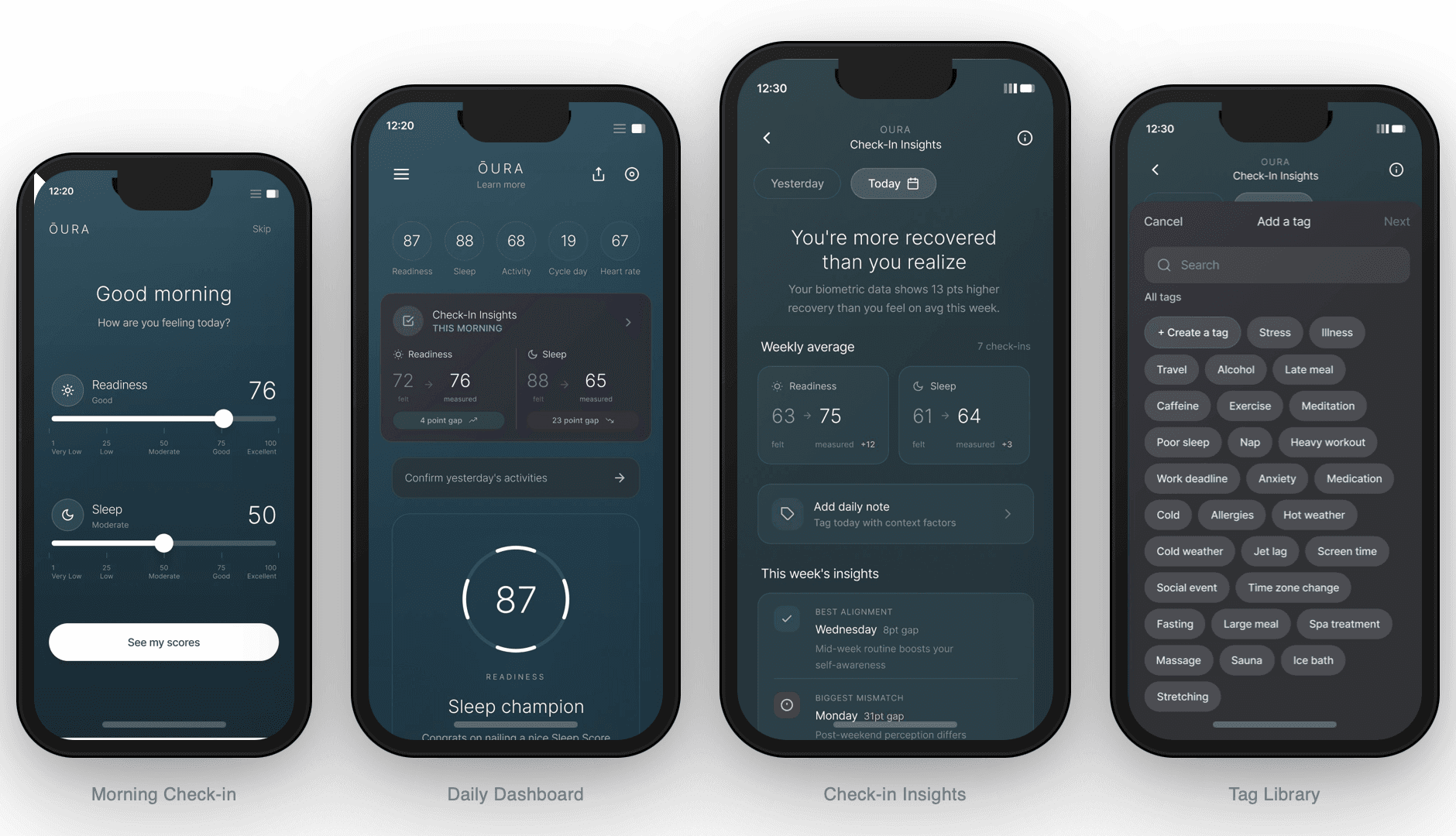
Each solution was designed as part of a connected system that moves users from passive data consumption to deeper understanding over time.
Giving users a voice before the data: the morning check-in
Users already formed an expectation before opening the app, but had no way to capture it. A lightweight check-in at app open allows users to quickly record how they feel before their scores are revealed, turning a passive habit into a more intentional starting point.
Competitive analysis insight
Most wearable experiences prioritize immediate score visibility, leaving little room for reflection and reinforcing passive engagement patterns.
Added feature after user testing
Input labels and microcopy were refined to reduce hesitation and make the interaction feel fast and intuitive. The skip option remained clearly visible to preserve flexibility and avoid friction.
View feature
Making the gap meaningful: felt vs. measured alignment
Seeing a score is not enough. Users need to understand how it relates to how they feel. The score reveal surfaces both in the same moment, placing subjective input alongside biometric data so the comparison is immediate and easy to interpret.
Competitive analysis insight
Many platforms respond to confusion by adding more data, but fail to explain why scores may feel misaligned, which weakens trust.
Added feature after user testing
Directional cues and contextual labels were introduced to clarify whether users overestimated or underestimated their recovery, improving comprehension and reducing ambiguity.
View feature
Turning daily inputs into patterns users can trust
Single-day scores provide limited value without context. A trend view connects subjective input with biometric data over time, helping users recognize patterns, consistency, and long-term progress.
Competitive analysis insight
Wearable platforms focus on daily metrics but provide limited tools for understanding how personal perception and data align over time, missing an opportunity to drive deeper engagement.
Added feature after user testing
Key insights and trend summaries were surfaced more prominently, making patterns easier to scan and reinforcing the long-term value of consistent engagement.
View feature
Validating what works and revealing what to improve
Usability testing validated that users could complete the daily self check quickly and understand how it connects to their biometric data, reinforcing a fast and intuitive experience.
Complete daily self check
Interpret alignment between felt and measured data
Performance metrics
100% task completion - All participants successfully completed the daily check-in without assistance.
80% immediate comprehension - Most users understood the relationship between how they felt and their data without additional explanation.
38s avg. completion time - Users completed the interaction well under the 60 seconds goal, maintaining a low-friction experience.
Key Insights That Shaped the Next Iteration
Clarity of check-in inputs needed improvement - Some users hesitated when completing the self check, indicating uncertainty around what they were being asked to rate and how to interpret each input.
Connection between input and data needed stronger reinforcement - While users found the concept valuable, not all immediately understood how their input influenced the insights shown, creating a gap in interpretation.
Alignment insights needed clearer prioritization - Users consistently identified alignment as the most valuable part of the experience, but its placement and visibility did not always reflect its importance.